








I’m Junie Castellano, and here’s why FoxJive exists
I spent a decade backstage teasing, pinning, and setting hair for period stage productions before I ever wrote a word of this down.
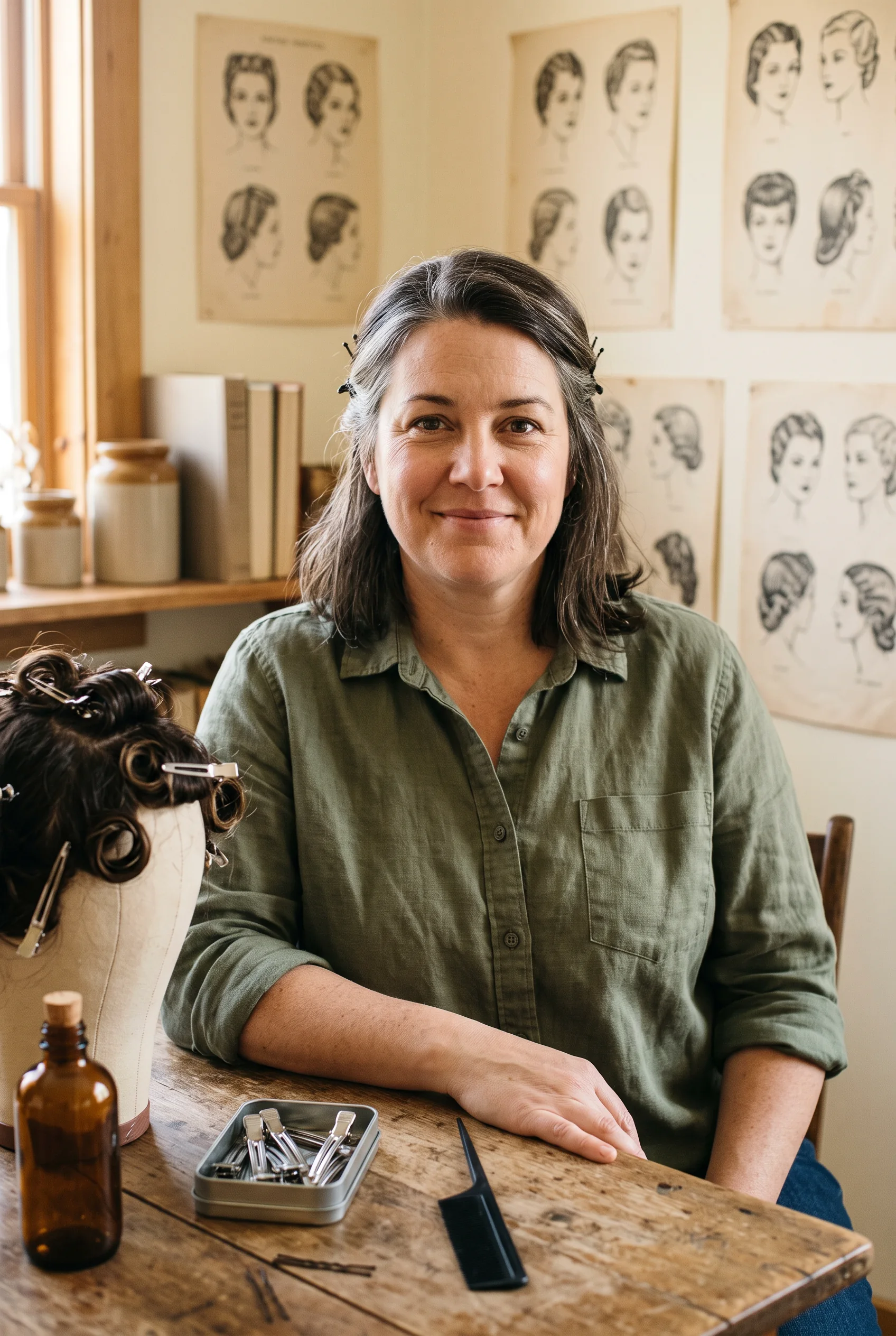
Floors, Then Foils
In 1999, at nineteen, I swept hair off the floor at Highland House of Beauty in Modesto, California, for four dollars an hour above minimum wage. I’d dropped out of a general studies program at Modesto Junior College the semester before, mostly because I couldn’t explain to anyone what I wanted from it. The salon owner, a woman named Carol Anne Pruitt, handed me a copy of a 1962 Wella styling manual and told me to memorize the finger-wave diagrams before she’d let me touch a client’s head.
She was serious about it. It took me eight months of practicing on mannequin heads before she let me set a real client’s hair, and another year after that before she trusted me with a finger wave that wouldn’t fall apart by lunch. A typical morning back then meant arriving before the salon opened to comb out and re-pin a mannequin head six or seven times, checking each wave against the diagrams in that Wella manual until my thumb had a permanent groove from the clip. Carol Anne would walk by, glance at my work, and say nothing, which I eventually learned meant it was close enough to try on someone real the following week. That kind of training stuck with me longer than anything else from that job, and it’s still how I approach every technique I teach now: no shortcuts until the fundamentals hold on their own.
Why Decades, Not Trends
In 2002 I left Modesto for Sacramento to work as a wig and hair stylist for Sacramento Music Circus, doing period productions for ten years. Every show meant researching a specific year, sometimes a specific month, because a 1943 victory roll and a 1948 one aren’t the same silhouette, and a costume designer would catch the difference even if the audience never did. Early on I got this wrong in a way that cost me a redo two days before opening night: I built a 1946 set using a 1952 roller pattern because I’d assumed the two years were close enough to blur together. The director noticed immediately, and I spent an evening unpicking pin curls I’d already lacquered into place, which is its own kind of miserable.
That job taught me a decade isn’t a mood board. It’s a set of engineering decisions: how the hair was cut to hold a shape, what tools existed at the time, how women slept in their sets without wrecking them by morning. I started keeping a notebook, dated by production, listing which roller sizes, which pin patterns, and which setting lotions matched which year, and I still reach for a version of that notebook today, along with a set of vintage-style metal clips and a bottle of Lottabody setting lotion that behaves closer to what a 1950s home stylist would have used than most modern mousse does. When I explain a hairstyle now, I start with what problem it solved for someone in that decade, then figure out what still solves a problem for someone getting ready on a Tuesday in 2025.
Who FoxJive Is For, And What I Won’t Do
FoxJive is for women who want a specific era’s shape without walking around looking like they raided a costume rack for a party. If you want a 1950s set that reads as sleek instead of sitcom, or a 1970s shag that doesn’t need a wig cap and three cans of hairspray, this site is written for you. It is not for anyone looking for a five-minute hack, a filter-friendly approximation meant to last one photo, or a claim that any style works the same on four-inch hair as it does on hair past the shoulder.
I won’t publish a tutorial I haven’t done on my own hair or a model’s hair first, and I won’t round a technique down to ‘get the vintage look’ in three bullet points. I also won’t pretend every style works on every hair type or length. When a technique depends on virgin 1940s-length hair, a specific perm rod size, or a set-and-sleep routine most people won’t keep up, I say so instead of promising a shortcut that doesn’t exist. If someone writes in asking for a faster version of a set that genuinely requires an overnight process, I tell them the honest timeline rather than inventing a version that photographs fine and falls apart by dinner.
How I Check What I Publish
Every tutorial on FoxJive gets tested at least twice before it goes up, once by me and once by a stylist I work with, Renata Ibarra, who trained at a different salon than I did and catches things I miss, usually around timing or a step I’ve done so many times I forget to mention it. When I reference a decade’s dominant technique, I cross-check it against period trade manuals from my own collection, along with digitized issues of Modern Beauty Shop magazine from the 1940s through the 1970s, comparing the diagrams against photographs from the same year whenever I can find them.
If I get a date or a technique wrong, I correct the post and note the change at the bottom rather than quietly editing it out. That’s happened four times since 2013, and I’d rather list those corrections publicly than pretend this site has never made one. One of those corrections involved a roller size I’d misread from a faded manual page, and Renata caught it during a routine test set months after the original post went live.
Twelve Years In
I started FoxJive in 2013 out of a spare bedroom in Sacramento, writing up the techniques I’d used backstage for a decade because I kept fielding the same questions from friends who wanted a retro style for a wedding or a photo shoot and didn’t know where to start. Twelve years and a few hundred tutorials later, the questions haven’t changed much. Women still want the shape without living in rollers every single night.
That’s still the job. I’m forty-five now, twenty-six years past that first broom at Highland House of Beauty, and I still test every set on my own head before I ask anyone else to try it. If it doesn’t hold for me, it doesn’t go on the site.
Want to reach me?
I read every message myself, whether it’s a question about a specific decade’s technique, a correction on something I got wrong, or a photo of how a tutorial turned out on your hair. You can find me on Pinterest or send a direct message through the contact page.
Business and collaboration inquiries go to [email protected].
Keep your pins sharp. — Junie