






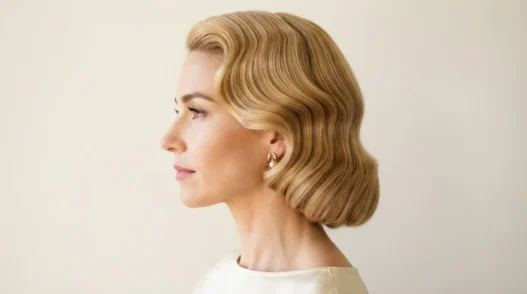
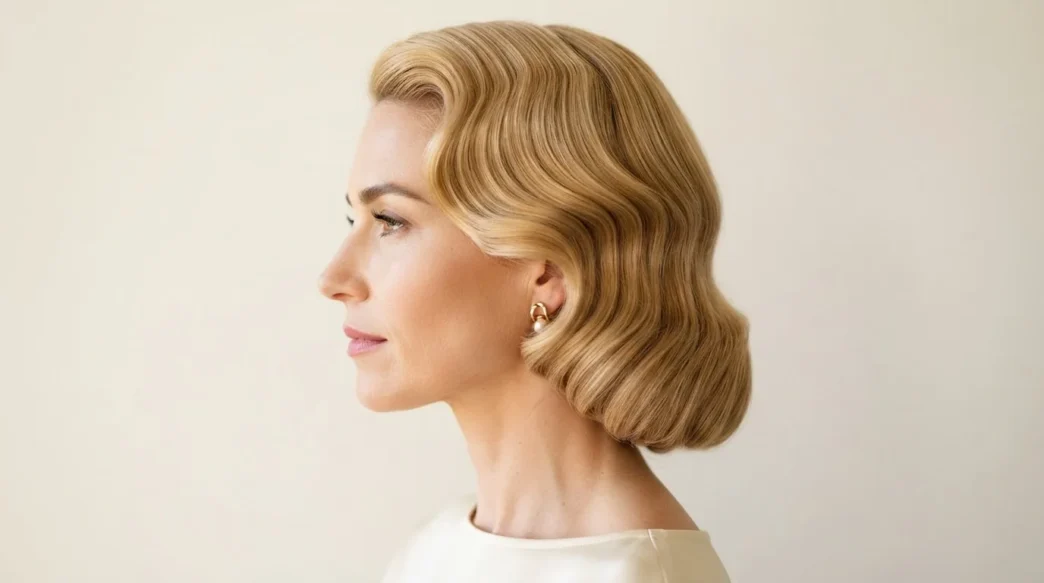
I became mildly obsessed with the bombshell blonde look somewhere between rewatching Gentlemen Prefer Blondes for the third time and completely ruining a perfectly good roller set. That obsession sent me deep into vintage beauty manuals, old salon training films, and more forum rabbit holes than I care to admit. And what I found is this: almost everything the internet repeats about achieving this look is wrong — not maliciously wrong, but wrong in that frustrating way where the advice started from something real and then got garbled in the retelling.
Where the Myths Started
The bombshell blonde archetype crystallized in the late 1940s and hit full fever pitch through the 1950s and early 60s. Think Jean Harlow’s platinum predecessor in the 30s, then the warmer, softer golden versions that followed — all waves, all volume, all that particular luminous glow that reads as golden even in black and white photographs. These women had full studio hair departments. They had colorists, pin curl specialists, and finishing teams. Their results were collaborative, painstaking, and built on a foundation of technique that was never fully written down for public consumption.
So when the look got popular again — and it cycles back every decade or so — people reverse-engineered it from photographs. Flat images. Images that don’t show the under-structure, the staging, the products, or the setting pattern. Myths are what fill the gap between the photograph and the process. Most of them started from a reasonable guess. That’s actually what makes them so sticky.
The Claim: Bleaching is the First Step
What people say
If you want bombshell blonde, go platinum first. Strip it all the way down, then tone. This is the advice that circles endlessly on beauty forums, and it’s delivered with total confidence by people who have clearly never seen a 1953 professional colorist’s notes.
What actually happened
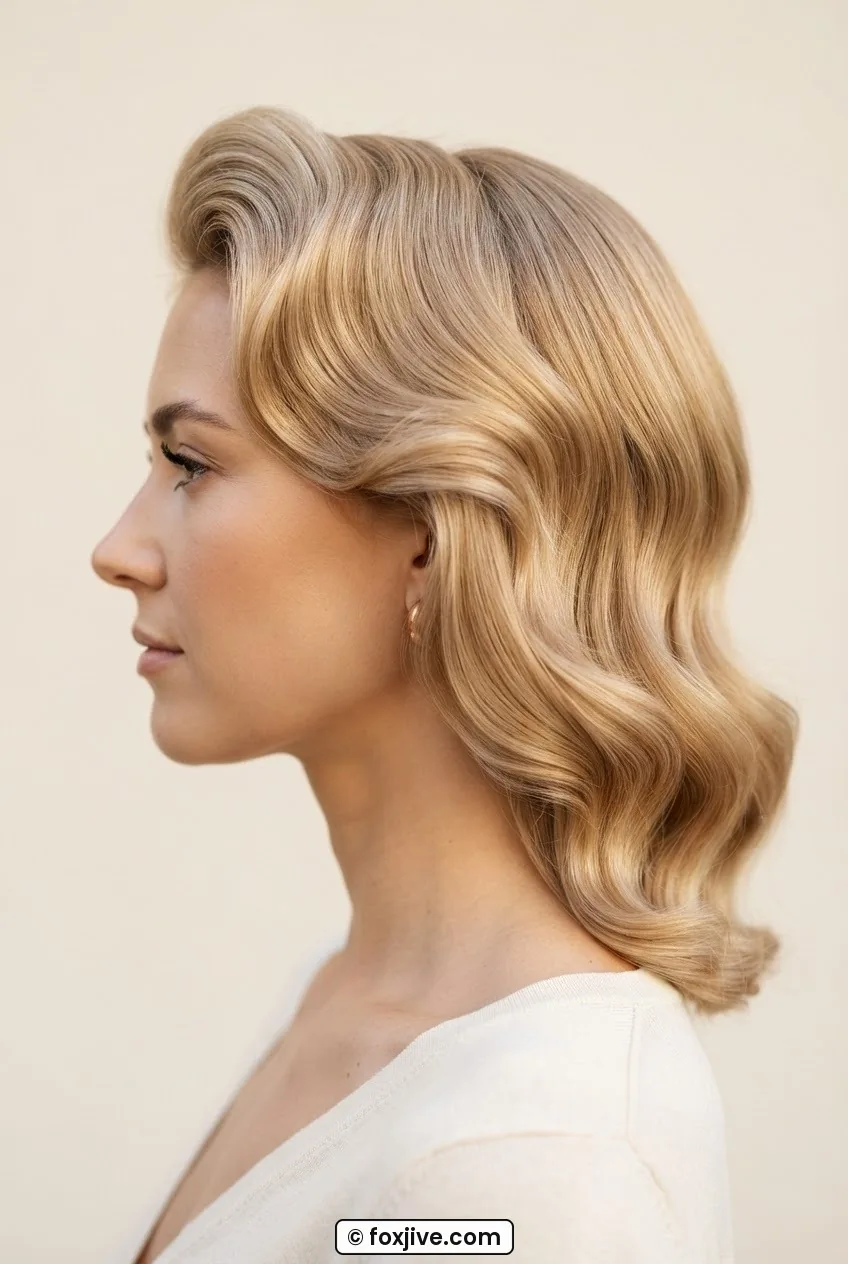
The classic bombshell shade is not platinum. It is warm golden blonde — sometimes called champagne, sometimes honey, often described by period colorists as “golden ash.” Platinum reads cold and sharp in person. The warm, almost three-dimensional glow in those iconic photographs comes from a shade that sits a full two to three levels warmer than platinum. Jean Harlow was the outlier. Marilyn was actually a warm blonde. So was Jayne Mansfield. So was every carefully coiffed screen siren whose image we’ve been studying.
The grain of truth: bleaching is involved. You can’t achieve that lifted, luminous result on a dark base without lightening. But stripping all the way to a cold platinum and then trying to warm it back up with toner is technically inefficient, more damaging than necessary, and frequently produces a result that’s too stark. The better approach — which vintage colorists knew — was to lift to the right warm level and stop there. You can read up on warm golden blonde color techniques before you commit, because stopping at the right level is everything.
The Claim: It’s All About the Color, Not the Cut
This one frustrates me the most. I’ve seen countless tutorials — good ones, by skilled people — that spend forty-five minutes on the coloring process and then briefly mention “and then style as desired.” As desired. As if the architecture of the style is an afterthought.
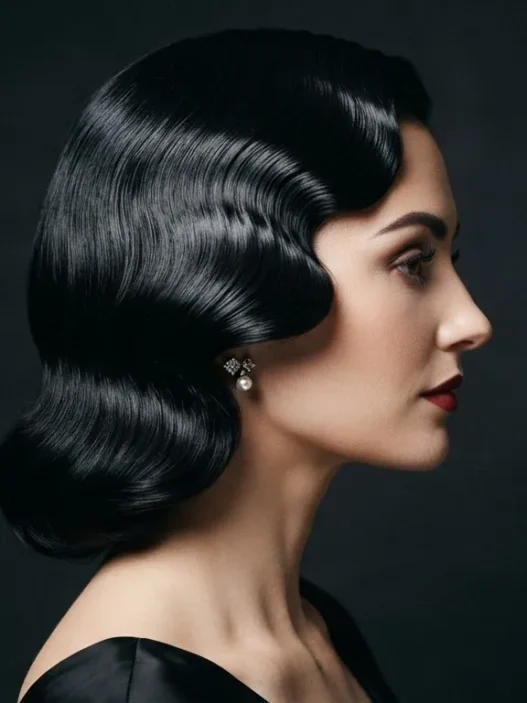
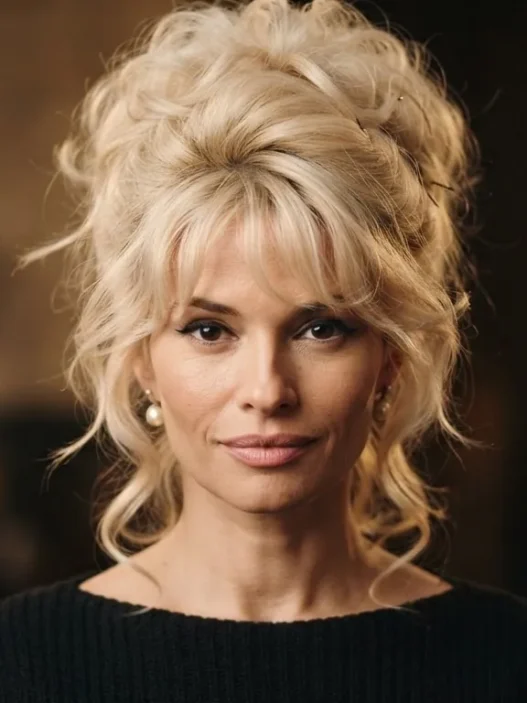
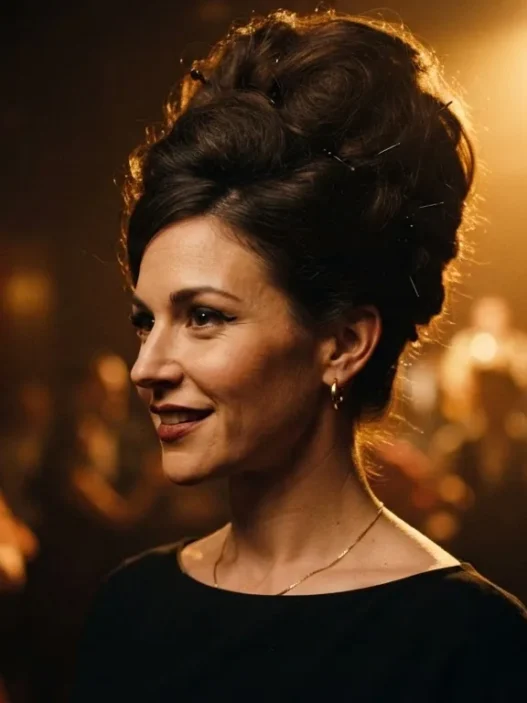
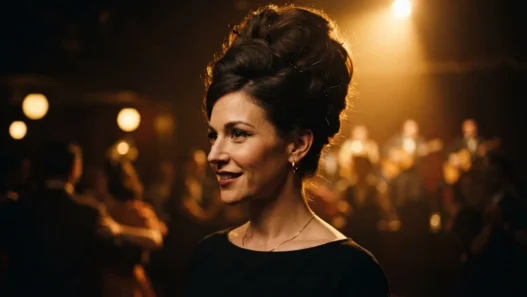
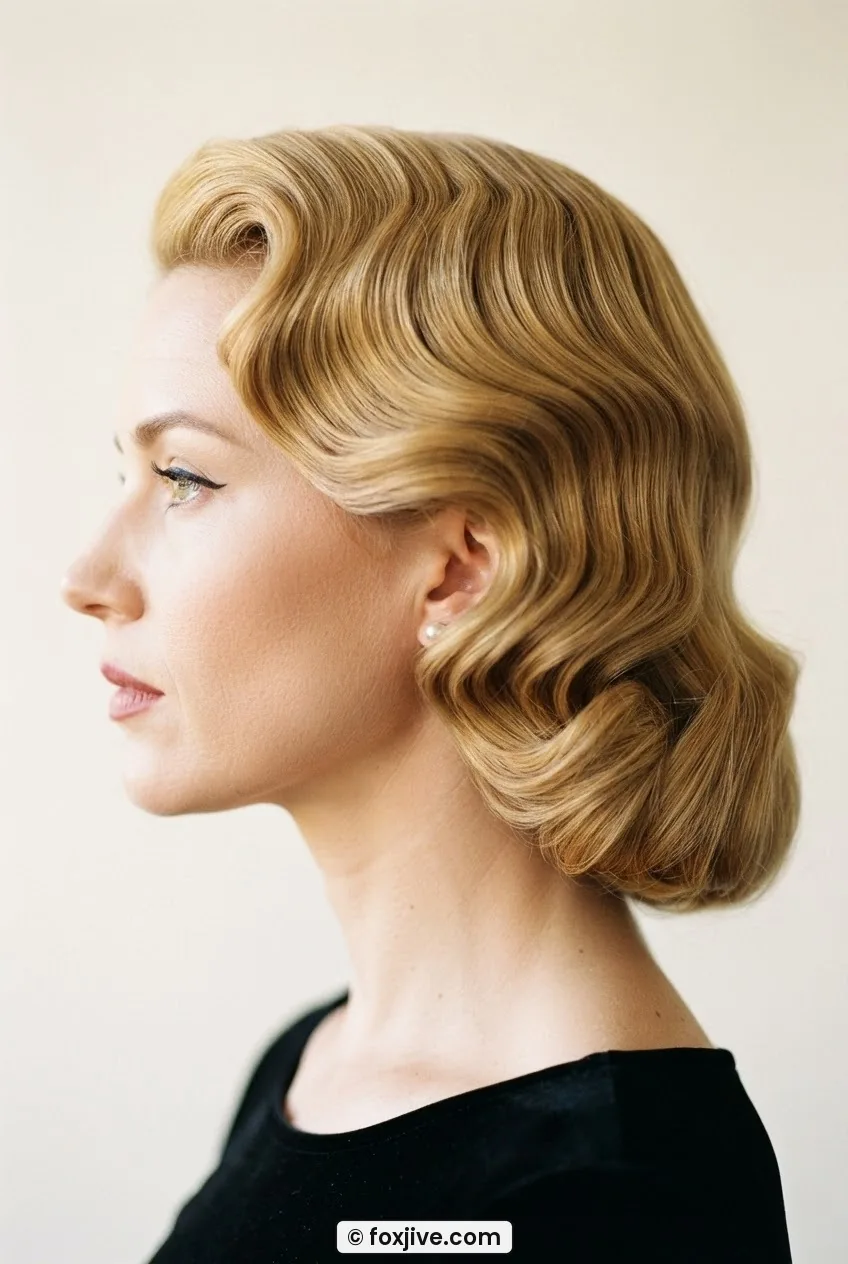
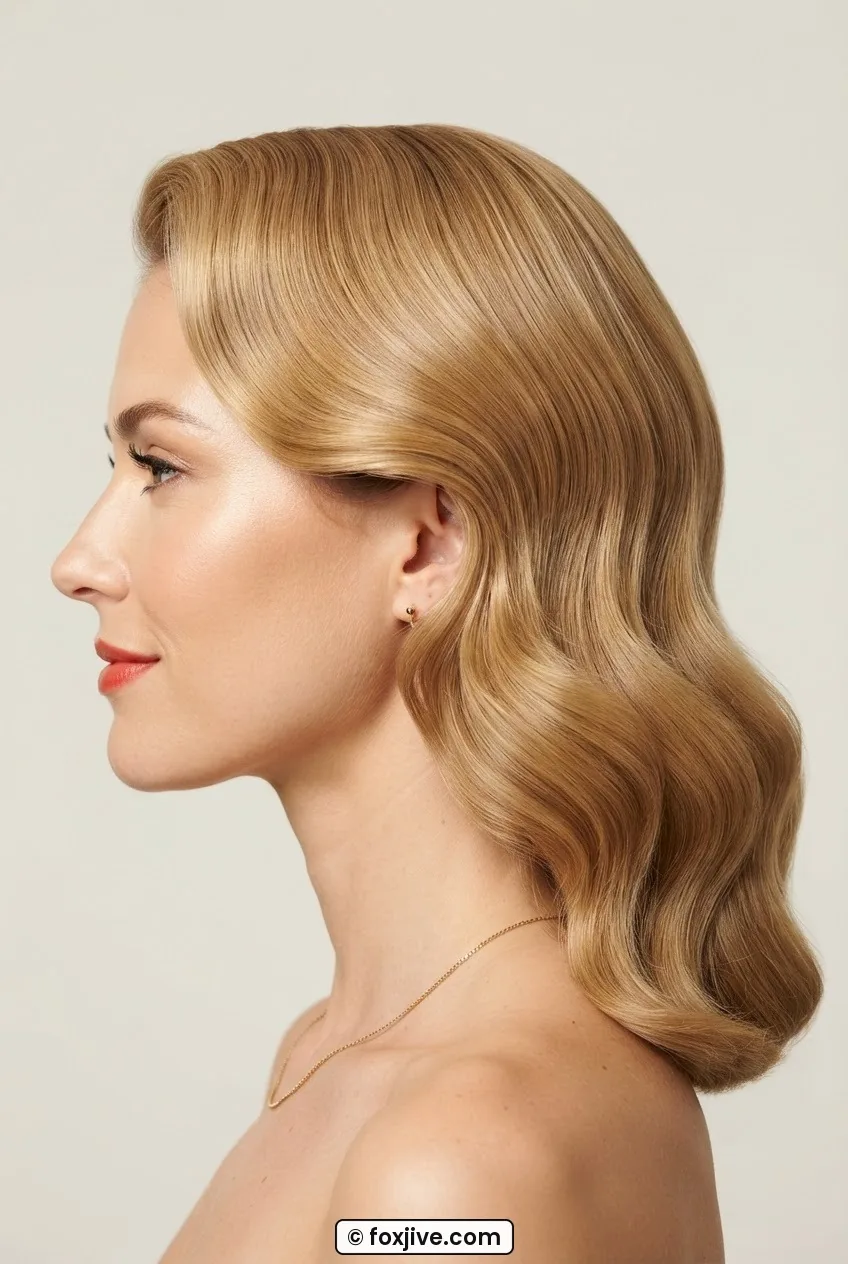
Look at her in this photo — the woman has this extraordinary shape that starts with the volume sitting high at the crown and then falls into a soft, rounded silhouette at the nape. That shape does not happen by accident. It comes from a specific cut: weight removed underneath to prevent bulk at the bottom, length kept long enough to set, layers placed so that the wave pattern has something to work with. The color is beautiful, yes. But without that cut, the color would sit flat and shapeless.
Vintage stylists were trained in something called “cut for the set” — meaning the haircut was designed specifically to support whatever setting pattern you planned to use. A roller set needs different weight distribution than a pin curl set. This is foundational knowledge that got largely lost when blow-drying replaced wet-setting as the default. The myth grew because color is visible in photographs and under-cutting technique is invisible. But if you go to a stylist and ask only for the color without discussing the underlying cut structure, you will get a beautiful color on a shape that can’t hold the style. The cut comes first, or at least comes simultaneously — and if you’re not sure where to start on this site, the Foxjive.com archives are genuinely one of the better organized resources for understanding how decade-specific structures differ.
The Claim: You Need a Diffuser for Those Waves
I understand where this came from. Diffusers enhance natural wave and curl patterns. The bombshell look is defined by waves. Therefore: diffuser. It’s a logical chain that leads you to completely the wrong destination.
The actual technique
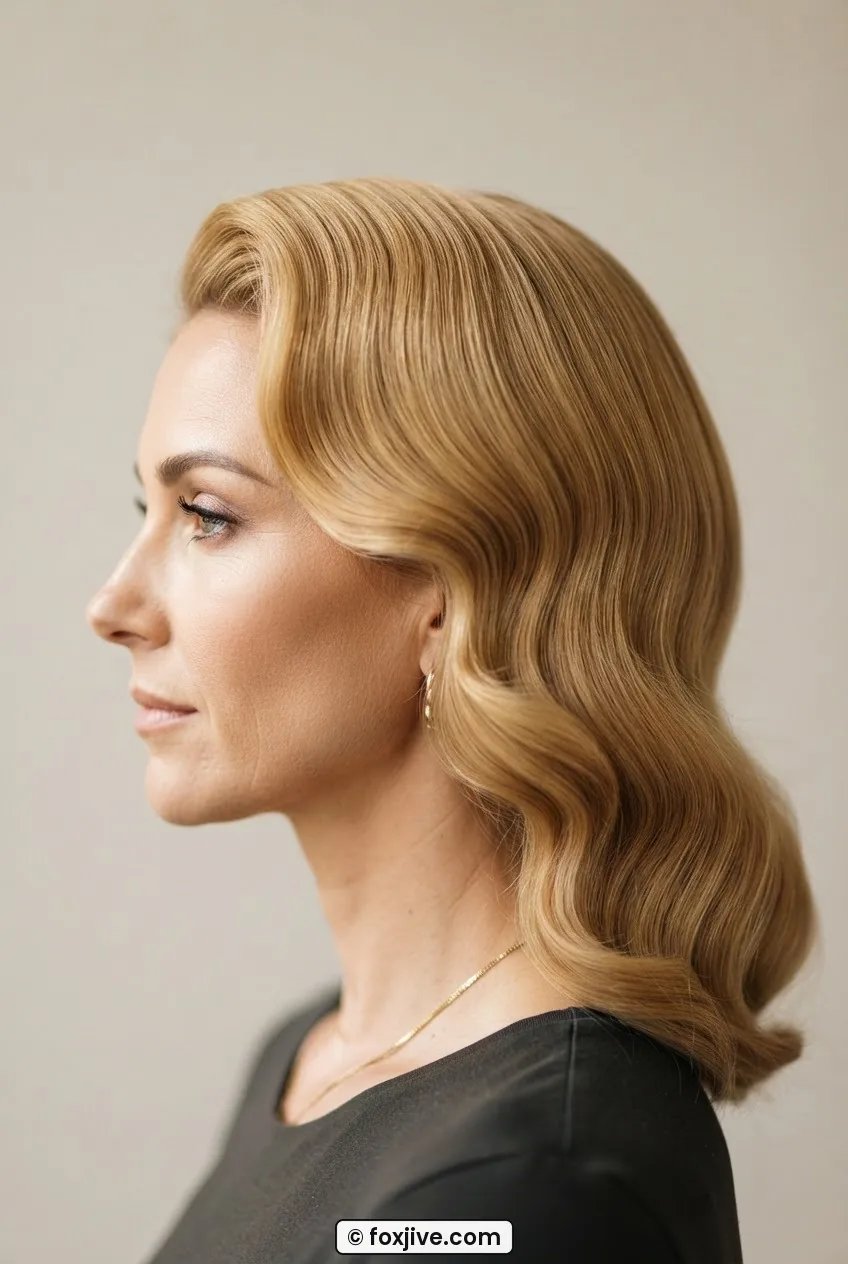
Those waves are not natural waves enhanced by a diffuser. They are set waves — structured, deliberate, placed by rollers or pin curls while wet, then dried under a hood dryer (or air dried, or dried under a dryer bonnet), and then brushed out. The brushing-out step is where the wave actually forms. Pin curls and rollers create the raw material — tight curl cylinders — and the act of brushing those out, working them together while still slightly warm, is what produces the broad, sweeping wave. No diffuser in the world produces that. A diffuser gives you softer, more organic movement. Beautiful, but categorically different.
The grain of truth here is that some modern stylists use a diffuser as part of a heat-activated wave process. There are also some excellent hybrid techniques that work for those who find traditional wet-setting too time-consuming. But if you want the authentic silhouette — the one you see when you look at photographs from that era — you need to learn the pin curl setting method and practice the brush-out. There is no shortcut that produces the same result. I’ve tried most of them. The shape in that photo up top — see how the wave is broad, smooth, and moves as one cohesive surface rather than as individual defined curls? That only comes from a brush-out.
It’s also worth noting that pin curls and their relationship to the full bombshell style are closely tied to the 1940s tradition — there’s a wonderful breakdown of Victory Rolls that illustrates how the same setting foundations that created that era’s iconic silhouettes also directly fed into the 1950s bombshell wave. The techniques share DNA. If you understand one, the other makes much more sense.
A Set and Brush-Out That Speaks for Itself
The Claim: It Only Works on Naturally Straight Hair
This one is a myth that excludes people, which makes me especially motivated to correct it.
The claim usually goes like this: the bombshell blonde wave requires a smooth base to work from, so naturally curly or coily hair can’t achieve it without extensive chemical straightening first. I’ve seen this repeated in otherwise thoughtful vintage style communities, and it’s wrong in a way that has a real cost — it makes people feel like a look is unavailable to them when it actually isn’t.
Here’s what’s true: naturally wavy or loosely curly hair actually responds beautifully to roller sets and pin curl techniques, sometimes better than naturally straight hair does, because there’s existing wave memory in the hair shaft. Tighter curl patterns do require more nuanced approach — a stronger setting lotion, longer drying time, a gentler brush-out — but “more nuanced” is not the same as “impossible.” What the technique does require, regardless of natural texture, is that the hair be set while damp and allowed to dry completely before brushing. That’s the non-negotiable. Natural texture is not.
The myth probably originated from the fact that vintage salon training materials were written with a very narrow range of hair textures in mind. The manuals described straight-to-wavy hair because that’s who was walking into those particular salons. It wasn’t a statement about what the technique could do — it was a description of the client base those authors knew. Context collapsed over time, and a description became a prescription. If you’re curious about specific adaptation techniques for different textures, there are some really practical examples over at 9 Victory Roll Ideas Ranked by How Long They Take — the same setting logic applies across styles from this whole era.
The Advice Worth Actually Keeping
Not all of the common wisdom is wrong. Some of it is genuinely good, even if it gets applied in the wrong context or with the wrong emphasis. Here’s what I’d keep from the popular advice:
- Toning matters enormously. Even if you don’t go platinum, toning after lightening is what gives the blonde its particular quality — the warmth, the evenness, the way it catches light. Skipping the toner is skipping the finish coat on a painting.
- Shine is structural. The bombshell look reads as luminous partly because of color but more because the wave surface is smooth and reflective. Products that create frizz or texture work against you here. A light setting lotion and a finishing serum after brush-out are genuinely useful.
- Maintenance intervals are shorter than you think. The look depends on volume and shape. Both collapse faster than most modern styles because they rely on setting rather than internal structure. Weekly sets are not high-maintenance — they are the actual cadence this style was designed for.
- Heat protection was practiced, just differently. The advice to protect your hair from heat damage is correct and important. What you can learn from protecting hair during heat styling is that vintage stylists relied more on tension-free drying methods precisely because they understood repeated heat exposure degraded the result.
The throughline in all of this is that the bombshell blonde look was never a single product or a single step. It was a system — color, cut, set, and finish — and each element was designed to support the others. When the system gets broken into isolated pieces and shared as independent tips, something always gets lost. Usually the most important part.
Questions I Get About This
Does the bombshell blonde look require professional coloring, or can I do it at home?
Honestly, the setting and styling absolutely can be done at home — vintage hair setting is one of the most DIY-friendly techniques out there, and there’s something satisfying about learning it. The coloring is where I’d be more cautious. Getting warm golden blonde right requires reading how your specific hair lifts, and stopping at the correct level takes experience. Box kits are designed for straight-to-the-point results, not nuanced warm tones. A colorist who understands vintage-inspired color is worth the investment for at least the initial color appointment.
How long does a proper roller set take to achieve the bombshell wave?
The actual setting takes about 20–30 minutes once you’ve practiced it. Drying time is the variable — anywhere from 45 minutes under a hood dryer to two hours air-drying. The brush-out itself, done properly, takes another 10–15 minutes. So realistically, block out two to three hours from damp hair to finished style. It sounds like a lot until you realize it’s mostly passive waiting time while your hair dries.
Can the bombshell blonde look be adapted for shorter hair?
Yes, but the mechanics shift. Shorter hair — chin-length and above — relies more on pin curls than on rollers, and the resulting wave is tighter and more structured rather than the sweeping full-length wave you see in the classic images. It’s a slightly different look within the same aesthetic family. Chin-length sets are actually faster and in some ways more forgiving. The about page here gives some context on the range of vintage looks this site covers, which includes those shorter structured sets as their own category.
What setting lotion did vintage stylists actually use?
Mostly very light, water-based solutions — some as simple as diluted flaxseed gel, others commercial setting lotions that were genuinely thin and fast-drying. The modern tendency to use heavy curl creams or mousses on a vintage set produces a different result: too much texture, not enough smoothness for the brush-out. Lighter is almost always better for this technique. Look for anything labeled “setting lotion” or “wave lotion” rather than a product designed for defining natural curl.
If you’ve been chasing this look and coming up disappointed, I’d genuinely love to hear which of these myths you ran into first — they all have different victims. And if something here unlocked a piece of the puzzle for you, the contact page is always open. I read everything.